
SQL Exercise: Where was the final match of the EURO cup 2016 held?
1. From the following table, write a SQL query to find out where the final match of the EURO cup 2016 was played. Return venue name, city.
Sample table: soccer_venue
 venue_id |       venue_name        | city_id | aud_capacity
----------+-------------------------+---------+--------------
    20001 | Stade de Bordeaux       |   10003 |        42115
    20002 | Stade Bollaert-Delelis  |   10004 |        38223
    20003 | Stade Pierre Mauroy     |   10005 |        49822
    20004 | Stade de Lyon           |   10006 |        58585
    20005 | Stade VElodrome         |   10007 |        64354
    20006 | Stade de Nice           |   10008 |        35624
    20007 | Parc des Princes        |   10001 |        47294
    20008 | Stade de France         |   10002 |        80100
    20009 | Stade Geoffroy Guichard |   10009 |        42000
    20010 | Stadium de Toulouse     |   10010 |        33150
Sample table: soccer_city
 city_id |     city      | country_id
---------+---------------+------------
   10001 | Paris         |       1207
   10002 | Saint-Denis   |       1207
   10003 | Bordeaux      |       1207
   10004 | Lens          |       1207
   10005 | Lille         |       1207
   10006 | Lyon          |       1207
   10007 | Marseille     |       1207
   10008 | Nice          |       1207
   10009 | Saint-Etienne |       1207
   10010 | Toulouse      |       1207
Sample table: match_mast
 match_no | play_stage | play_date  | results | decided_by | goal_score | venue_id | referee_id | audence | plr_of_match | stop1_sec | stop2_sec
----------+------------+------------+---------+------------+------------+----------+------------+---------+--------------+-----------+-----------
        1 | G          | 2016-06-11 | WIN     | N          | 2-1        |    20008 |      70007 |   75113 |       160154 |       131 |       242
        2 | G          | 2016-06-11 | WIN     | N          | 0-1        |    20002 |      70012 |   33805 |       160476 |        61 |       182
        3 | G          | 2016-06-11 | WIN     | N          | 2-1        |    20001 |      70017 |   37831 |       160540 |        64 |       268
        4 | G          | 2016-06-12 | DRAW    | N          | 1-1        |    20005 |      70011 |   62343 |       160128 |         0 |       185
        5 | G          | 2016-06-12 | WIN     | N          | 0-1        |    20007 |      70006 |   43842 |       160084 |       125 |       325
        6 | G          | 2016-06-12 | WIN     | N          | 1-0        |    20006 |      70014 |   33742 |       160291 |         2 |       246
        7 | G          | 2016-06-13 | WIN     | N          | 2-0        |    20003 |      70002 |   43035 |       160176 |        89 |       188
        8 | G          | 2016-06-13 | WIN     | N          | 1-0        |    20010 |      70009 |   29400 |       160429 |       360 |       182
        9 | G          | 2016-06-13 | DRAW    | N          | 1-1        |    20008 |      70010 |   73419 |       160335 |        67 |       194
..........
       51 | F          | 2016-07-11 | WIN     | N          | 1-0        |    20008 |      70005 |   75868 |       160307 |       161 |       181
Sample Solution:
SQL Code:
-- Selecting venue_name and city
SELECT venue_name, city
FROM soccer_venue a
-- Joining soccer_venue with soccer_city using city_id
JOIN soccer_city b ON a.city_id = b.city_id
-- Joining the result with match_mast using venue_id
JOIN match_mast d ON d.venue_id = a.venue_id
-- Filtering the results to include only matches in the final play stage
AND d.play_stage = 'F';
Sample Output:
   venue_name    |    city
-----------------+-------------
 Stade de France | Saint-Denis
(1 row)
Code Explanation:
The given query in SQL that returns a list of all the venue names and their corresponding cities where matches with play_stage 'F' were held..
The query uses two JOIN operations to link the soccer_venue and soccer_city tables based on the common city_id column. It then uses a third JOIN operation to link the match_mast table with the previous result set based on the common venue_id column. The ON condition for this JOIN specifies that only rows where the play_stage column equals 'F' (which likely stands for "finals") are included in the final result set.
Alternative Solutions:
Using Subquery with WHERE Clause:
-- Selecting venue_name and city
SELECT venue_name, city
FROM soccer_venue
-- Joining soccer_venue with soccer_city using city_id
JOIN soccer_city ON soccer_venue.city_id = soccer_city.city_id
-- Filtering the results to include only venues with venue_id in the subquery result
WHERE venue_id IN (
    -- Selecting venue_id from match_mast where play_stage is 'F'
    SELECT venue_id
    FROM match_mast
    WHERE play_stage = 'F'
);
Explanation:
This query uses a subquery in the WHERE clause to find the venue_id values where the play_stage is 'F'. Then, we perform an inner join between soccer_venue and soccer_city tables to get the venue_name and city.
Using EXISTS Subquery:
-- Selecting venue_name and city
SELECT venue_name, city
FROM soccer_venue
-- Joining soccer_venue with soccer_city using city_id
JOIN soccer_city ON soccer_venue.city_id = soccer_city.city_id
-- Using EXISTS to filter results based on a subquery condition
WHERE EXISTS (
    -- Selecting 1 (or any constant) from match_mast
    SELECT 1
    FROM match_mast
    -- Matching venue_id in both tables and checking for play_stage 'F'
    WHERE match_mast.venue_id = soccer_venue.venue_id
      AND play_stage = 'F'
);
Explanation:
This query uses an EXISTS subquery to check if there exists a match in the match_mast table with the same venue_id and play_stage is 'F'. If such a match is found, it includes the venue in the result.
Using INNER JOIN with WHERE Clause:
-- Selecting venue_name and city
SELECT venue_name, city
-- Inner joining soccer_venue with soccer_city using city_id
FROM soccer_venue
INNER JOIN soccer_city ON soccer_venue.city_id = soccer_city.city_id
-- Inner joining the result with match_mast using venue_id
INNER JOIN match_mast ON soccer_venue.venue_id = match_mast.venue_id
-- Filtering the results to include only matches in the final play stage
WHERE match_mast.play_stage = 'F';
Explanation:
This query uses INNER JOINs to combine the tables soccer_venue, soccer_city, and match_mast. It then applies a WHERE clause to filter the results where play_stage is 'F'.
Relational Algebra Expression:
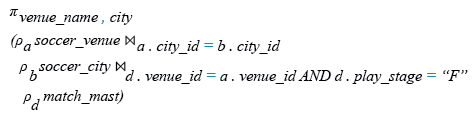
Relational Algebra Tree:
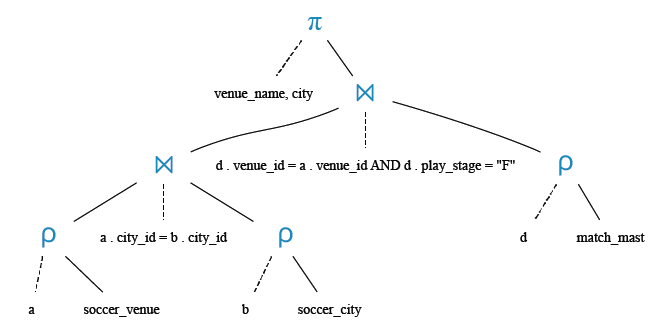
Go to:
PREV : SQL JOINS Exercises on Soccer Database
NEXT : Number of goals scored by each team in each match.
Practice Online
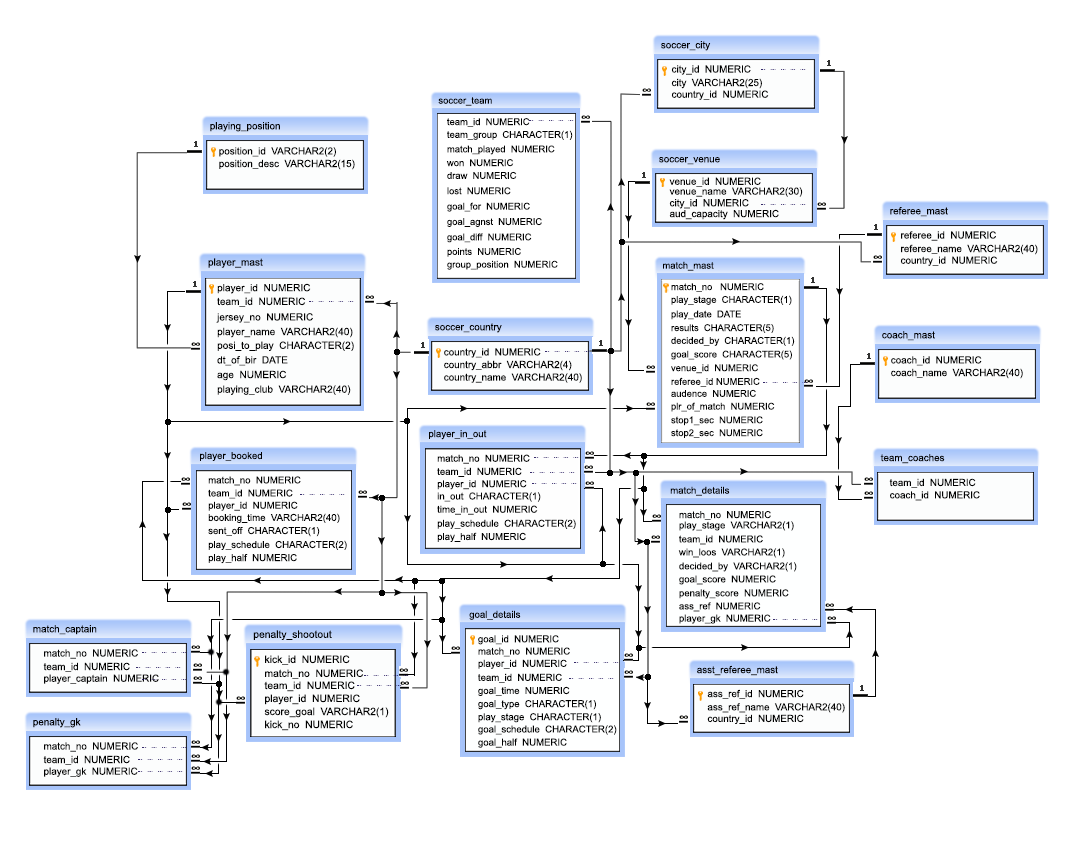
Sample Database: soccer
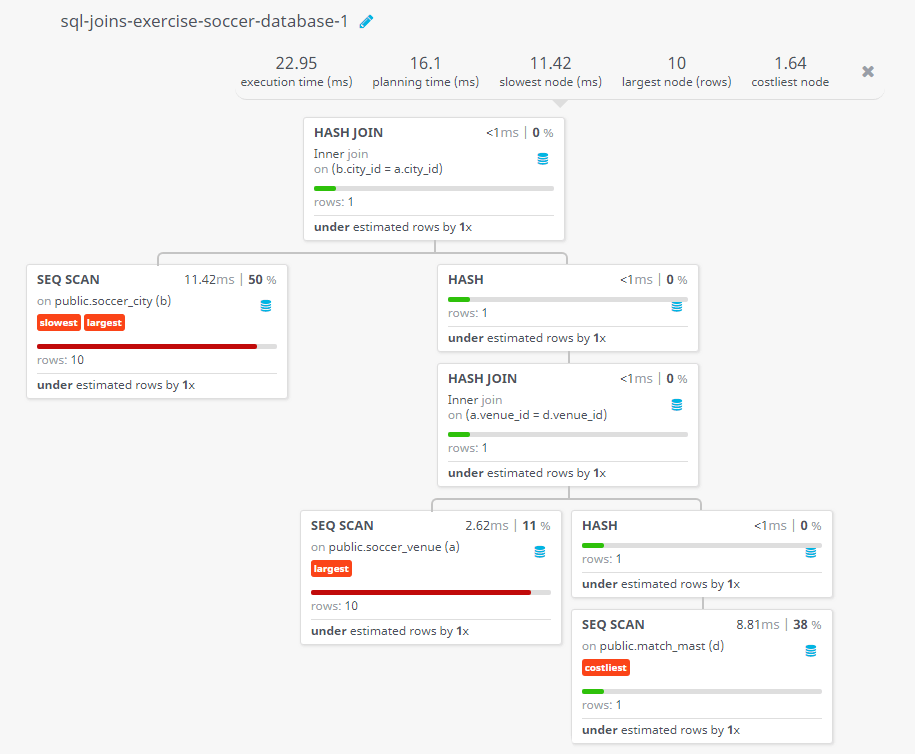
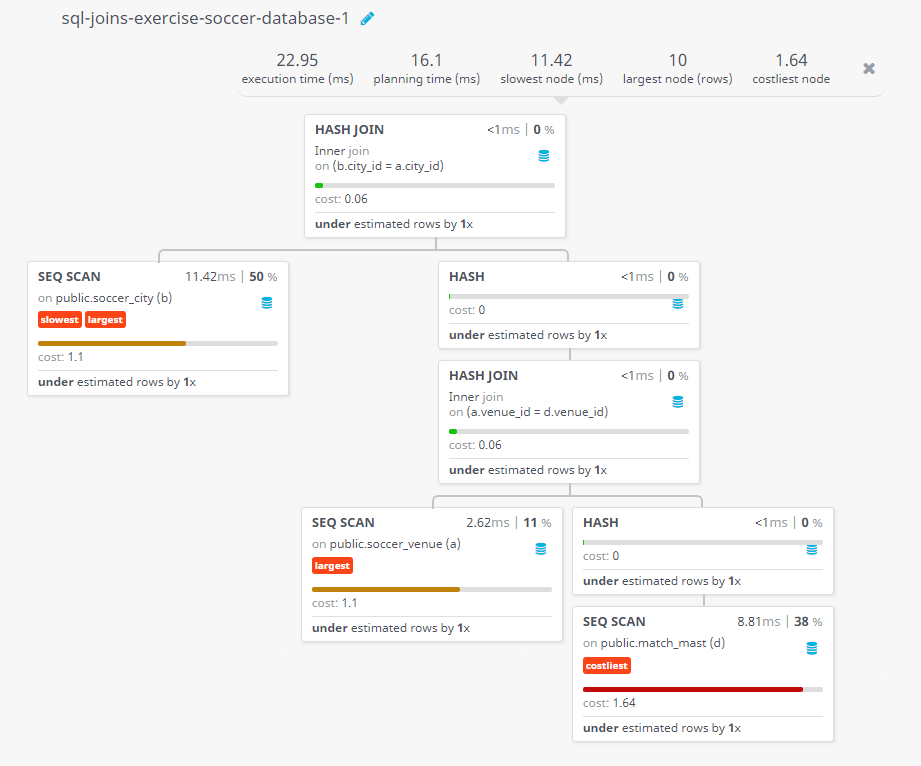
Query Visualization:
Duration:
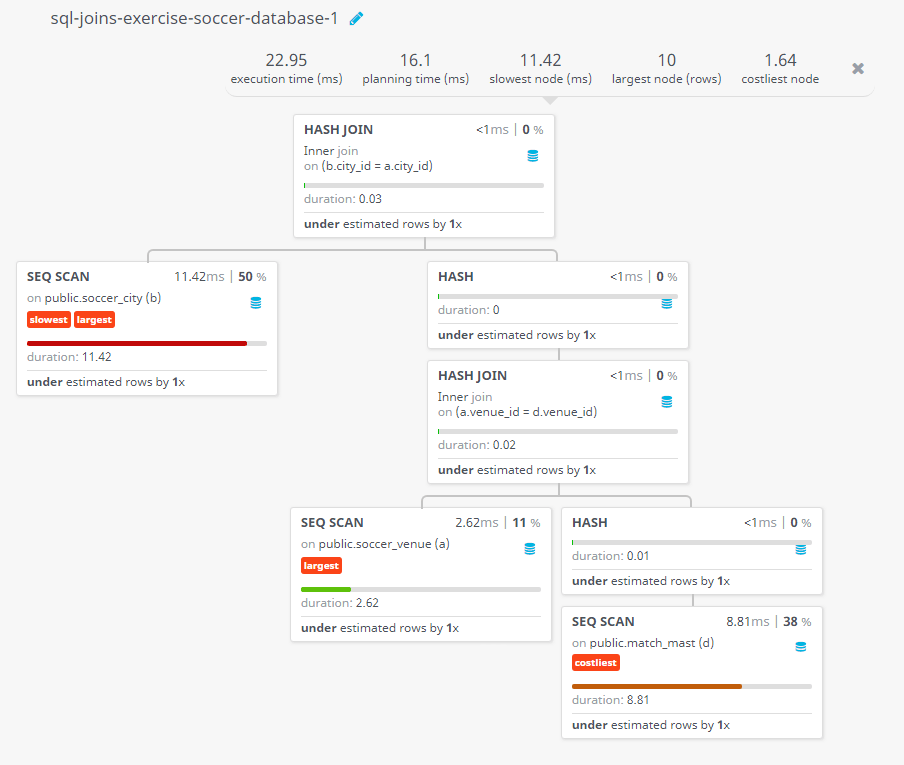
Rows:
Cost:
Have another way to solve this solution? Contribute your code (and comments) through Disqus.
What is the difficulty level of this exercise?
Test your Programming skills with w3resource's quiz.