
MySQL Aggregate Function Exercises: Get the department ID and the total salary payable in each department
MySQL Aggregate Function: Exercise-10 with Solution
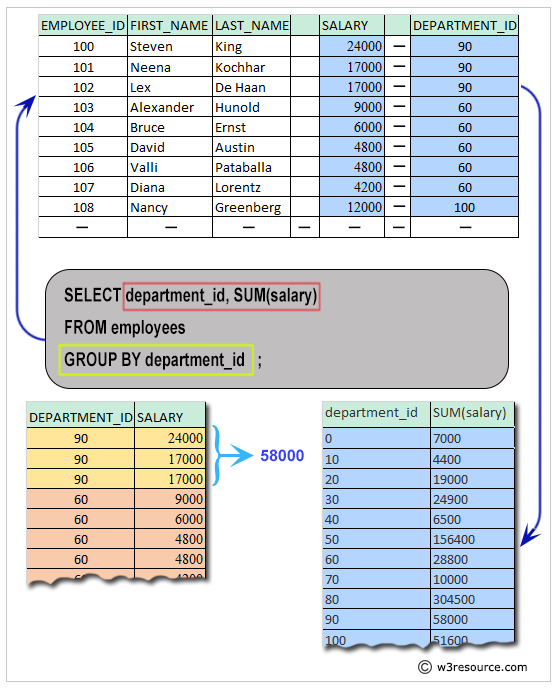
Write a query to get the department ID and the total salary payable in each department.
Sample table: employees
+-------------+-------------+-------------+----------+--------------------+------------+------------+----------+----------------+------------+---------------+
| EMPLOYEE_ID | FIRST_NAME  | LAST_NAME   | EMAIL    | PHONE_NUMBER       | HIRE_DATE  | JOB_ID     | SALARY   | COMMISSION_PCT | MANAGER_ID | DEPARTMENT_ID |
+-------------+-------------+-------------+----------+--------------------+------------+------------+----------+----------------+------------+---------------+
|         100 | Steven      | King        | SKING    | 515.123.4567       | 1987-06-17 | AD_PRES    | 24000.00 |           0.00 |          0 |   		  90 |
|         101 | Neena       | Kochhar     | NKOCHHAR | 515.123.4568       | 1987-06-18 | AD_VP      | 17000.00 |           0.00 |        100 |            90 |
|         102 | Lex         | De Haan     | LDEHAAN  | 515.123.4569       | 1987-06-19 | AD_VP      | 17000.00 |           0.00 |        100 |            90 |
|         103 | Alexander   | Hunold      | AHUNOLD  | 590.423.4567       | 1987-06-20 | IT_PROG    |  9000.00 |           0.00 |        102 |            60 |
|         104 | Bruce       | Ernst       | BERNST   | 590.423.4568       | 1987-06-21 | IT_PROG    |  6000.00 |           0.00 |        103 |            60 |
|         105 | David       | Austin      | DAUSTIN  | 590.423.4569       | 1987-06-22 | IT_PROG    |  4800.00 |           0.00 |        103 |            60 |
|         106 | Valli       | Pataballa   | VPATABAL | 590.423.4560       | 1987-06-23 | IT_PROG    |  4800.00 |           0.00 |        103 |            60 |
|         107 | Diana       | Lorentz     | DLORENTZ | 590.423.5567       | 1987-06-24 | IT_PROG    |  4200.00 |           0.00 |        103 |            60 |
|         108 | Nancy       | Greenberg   | NGREENBE | 515.124.4569       | 1987-06-25 | FI_MGR     | 12000.00 |           0.00 |        101 |           100 |
.........
|         206 | William     | Gietz       | WGIETZ   | 515.123.8181       | 1987-10-01 | AC_ACCOUNT |  8300.00 |           0.00 |        205 |           110 |
+-------------+-------------+-------------+----------+--------------------+------------+------------+----------+----------------+------------+---------------+
Code:
-- Calculating the total salary for each department
SELECT department_id, SUM(salary)
-- Selecting data from the employees table
FROM employees
-- Grouping the result set by department_id
GROUP BY department_id;
Explanation:
- This SQL query calculates the total salary for each department in the organization.
- The SELECT statement retrieves the department_id column and calculates the sum of salaries (SUM(salary)) for each department.
- The FROM clause specifies the employees table from which the data is being selected.
- The GROUP BY clause groups the result set by the department_id column, allowing for the aggregation of salaries for each department.
- This query is useful when you want to analyze the total salary expenditure for each department, helping to understand the distribution of resources.
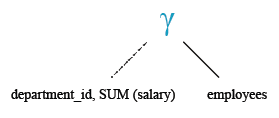
Relational Algebra Expression:

Relational Algebra Tree:
Pictorial Presentation of the above query
Go to:
PREV :Write a query to find the manager ID and the salary of the lowest-paid employee for that manager.
NEXT :Write a query to get the average salary for each job ID excluding programmer.
MySQL Code Editor:
Have another way to solve this solution? Contribute your code (and comments) through Disqus.
What is the difficulty level of this exercise?