
MySQL Joins Exercises: Get the department name and number of employees in the department
MySQL Joins: Exercise-6 with Solution
Write a MySQL query to get the department name and number of employees in the department.
Sample table: employees
+-------------+-------------+-------------+----------+--------------------+------------+------------+----------+----------------+------------+---------------+
| EMPLOYEE_ID | FIRST_NAME  | LAST_NAME   | EMAIL    | PHONE_NUMBER       | HIRE_DATE  | JOB_ID     | SALARY   | COMMISSION_PCT | MANAGER_ID | DEPARTMENT_ID |
+-------------+-------------+-------------+----------+--------------------+------------+------------+----------+----------------+------------+---------------+
|         100 | Steven      | King        | SKING    | 515.123.4567       | 1987-06-17 | AD_PRES    | 24000.00 |           0.00 |          0 |   		  90 |
|         101 | Neena       | Kochhar     | NKOCHHAR | 515.123.4568       | 1987-06-18 | AD_VP      | 17000.00 |           0.00 |        100 |            90 |
|         102 | Lex         | De Haan     | LDEHAAN  | 515.123.4569       | 1987-06-19 | AD_VP      | 17000.00 |           0.00 |        100 |            90 |
|         103 | Alexander   | Hunold      | AHUNOLD  | 590.423.4567       | 1987-06-20 | IT_PROG    |  9000.00 |           0.00 |        102 |            60 |
|         104 | Bruce       | Ernst       | BERNST   | 590.423.4568       | 1987-06-21 | IT_PROG    |  6000.00 |           0.00 |        103 |            60 |
|         105 | David       | Austin      | DAUSTIN  | 590.423.4569       | 1987-06-22 | IT_PROG    |  4800.00 |           0.00 |        103 |            60 |
|         106 | Valli       | Pataballa   | VPATABAL | 590.423.4560       | 1987-06-23 | IT_PROG    |  4800.00 |           0.00 |        103 |            60 |
|         107 | Diana       | Lorentz     | DLORENTZ | 590.423.5567       | 1987-06-24 | IT_PROG    |  4200.00 |           0.00 |        103 |            60 |
|         108 | Nancy       | Greenberg   | NGREENBE | 515.124.4569       | 1987-06-25 | FI_MGR     | 12000.00 |           0.00 |        101 |           100 |
............
|         206 | William     | Gietz       | WGIETZ   | 515.123.8181       | 1987-10-01 | AC_ACCOUNT |  8300.00 |           0.00 |        205 |           110 |
+-------------+-------------+-------------+----------+--------------------+------------+------------+----------+----------------+------------+---------------+
Sample table: departments
+---------------+----------------------+------------+-------------+
| DEPARTMENT_ID | DEPARTMENT_NAME      | MANAGER_ID | LOCATION_ID |
+---------------+----------------------+------------+-------------+
|            10 | Administration       |        200 |        1700 |
|            20 | Marketing            |        201 |        1800 |
|            30 | Purchasing           |        114 |        1700 |
|            40 | Human Resources      |        203 |        2400 |
|            50 | Shipping             |        121 |        1500 |
|            60 | IT                   |        103 |        1400 |
|            70 | Public Relations     |        204 |        2700 |
|            80 | Sales                |        145 |        2500 |
.........
|           270 | Payroll              |          0 |        1700 |
+---------------+----------------------+------------+-------------+
Code:
-- This SQL query retrieves the count of employees in each department, along with the department names, from the 'departments' and 'employees' tables.

SELECT
    department_name AS 'Department Name', -- Selecting the 'department_name' column from the 'departments' table and aliasing it as 'Department Name'.
    COUNT(*) AS 'No of Employees' -- Counting the number of records (employees) in each department and aliasing it as 'No of Employees'.
FROM
    departments -- Specifying the 'departments' table.
INNER JOIN
    employees -- Performing an inner join with the 'employees' table.
ON
    employees.department_id = departments.department_id -- Joining the 'employees' and 'departments' tables based on the 'department_id' column.
GROUP BY
    departments.department_id, department_name -- Grouping the result set by department ID and department name.
ORDER BY
    department_name; -- Ordering the result set by department name in ascending order.
Explanation:
- This SQL query retrieves the count of employees in each department along with the department names.
- It performs an inner join between the 'departments' and 'employees' tables based on the 'department_id' column to associate employees with their respective departments.
- The 'COUNT(*)' function is used to count the number of records (employees) in each department.
- The 'GROUP BY' clause groups the result set by department ID and department name to apply the aggregate function ('COUNT(*)') correctly.
Sample Output:
Department Name		No of Employees
Accounting			2
Administration			1
Executive			3
Finance				6
Human Resources			1
IT				5
Marketing			2
Public Relations		1
Purchasing			6
Sales				34
Shipping			45
Go to:
PREV :Write a MySQL query to find the name (first_name, last_name) and hire date of the employees who was hired after 'Jones'.
NEXT :Write a MySQL query to find the employee ID, job title, number of days between ending date and starting date for all jobs in department 90 from job history.
MySQL Code Editor:
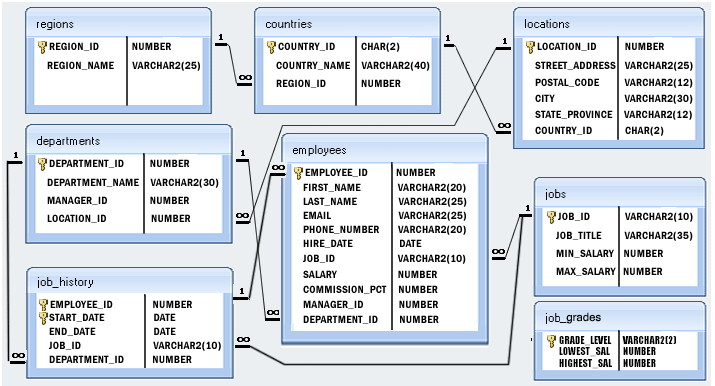
Structure of 'hr' database :
Have another way to solve this solution? Contribute your code (and comments) through Disqus.
What is the difficulty level of this exercise?