
SQL Exercise: Difference between highest and lowest salary for a job
23. From the following table, write a SQL query to count the number of employees, the sum of all salary, and difference between the highest salary and lowest salaries by each job id. Return job_id, count, sum, salary_difference.
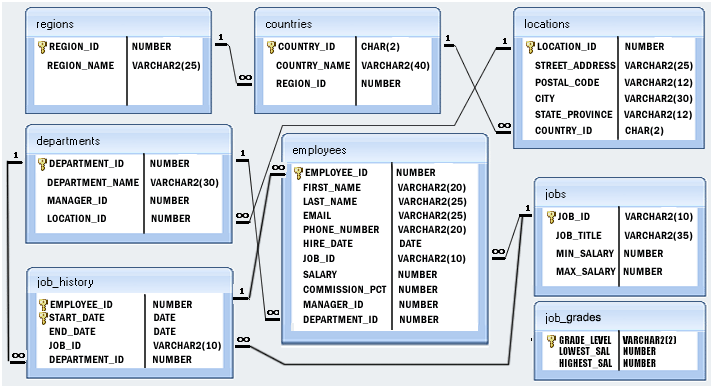
Sample table: employees+-------------+-------------+-------------+----------+--------------------+------------+------------+----------+----------------+------------+---------------+ | EMPLOYEE_ID | FIRST_NAME | LAST_NAME | EMAIL | PHONE_NUMBER | HIRE_DATE | JOB_ID | SALARY | COMMISSION_PCT | MANAGER_ID | DEPARTMENT_ID | +-------------+-------------+-------------+----------+--------------------+------------+------------+----------+----------------+------------+---------------+ | 100 | Steven | King | SKING | 515.123.4567 | 2003-06-17 | AD_PRES | 24000.00 | 0.00 | 0 | 90 | | 101 | Neena | Kochhar | NKOCHHAR | 515.123.4568 | 2005-09-21 | AD_VP | 17000.00 | 0.00 | 100 | 90 | | 102 | Lex | De Haan | LDEHAAN | 515.123.4569 | 2001-01-13 | AD_VP | 17000.00 | 0.00 | 100 | 90 | | 103 | Alexander | Hunold | AHUNOLD | 590.423.4567 | 2006-01-03 | IT_PROG | 9000.00 | 0.00 | 102 | 60 | | 104 | Bruce | Ernst | BERNST | 590.423.4568 | 2007-05-21 | IT_PROG | 6000.00 | 0.00 | 103 | 60 | | 105 | David | Austin | DAUSTIN | 590.423.4569 | 2005-06-25 | IT_PROG | 4800.00 | 0.00 | 103 | 60 | | 106 | Valli | Pataballa | VPATABAL | 590.423.4560 | 2006-02-05 | IT_PROG | 4800.00 | 0.00 | 103 | 60 | | 107 | Diana | Lorentz | DLORENTZ | 590.423.5567 | 2007-02-07 | IT_PROG | 4200.00 | 0.00 | 103 | 60 | | 108 | Nancy | Greenberg | NGREENBE | 515.124.4569 | 2002-08-17 | FI_MGR | 12008.00 | 0.00 | 101 | 100 | | 109 | Daniel | Faviet | DFAVIET | 515.124.4169 | 2002-08-16 | FI_ACCOUNT | 9000.00 | 0.00 | 108 | 100 | ...... | 206 | William | Gietz | WGIETZ | 515.123.8181 | 2002-06-07 | AC_ACCOUNT | 8300.00 | 0.00 | 205 | 110 | +-------------+-------------+-------------+----------+--------------------+------------+------------+----------+----------------+------------+---------------+
Sample Solution:
-- Selecting 'job_id', count of records, sum of 'salary', and the salary difference between maximum and minimum values
SELECT job_id, COUNT(*), SUM(salary), MAX(salary) - MIN(salary) AS salary_difference
-- Specifying the table to retrieve data from ('employees')
FROM employees
-- Grouping the results by 'job_id'
GROUP BY job_id;
Sample Output:
   job_id   | count |    sum    | salary_difference
------------+-------+-----------+-------------------
 AC_ACCOUNT |     1 |   8300.00 |              0.00
 ST_MAN     |     5 |  36400.00 |           2400.00
 IT_PROG    |     5 |  28800.00 |           4800.00
 SA_MAN     |     5 |  61000.00 |           3500.00
 AD_PRES    |     1 |  24000.00 |              0.00
 AC_MGR     |     1 |  12000.00 |              0.00
 FI_MGR     |     1 |  12000.00 |              0.00
 AD_ASST    |     1 |   4400.00 |              0.00
 MK_MAN     |     1 |  13000.00 |              0.00
 PU_CLERK   |     5 |  13900.00 |            600.00
 HR_REP     |     1 |   6500.00 |              0.00
 PR_REP     |     1 |  10000.00 |              0.00
 FI_ACCOUNT |     5 |  39600.00 |           2100.00
 SH_CLERK   |    20 |  64300.00 |           1700.00
 AD_VP      |     2 |  34000.00 |              0.00
 SA_REP     |    30 | 250500.00 |           5400.00
 ST_CLERK   |    20 |  55700.00 |           1500.00
 MK_REP     |     1 |   6000.00 |              0.00
 PU_MAN     |     1 |  11000.00 |              0.00
(19 rows)
Code Explanation:
The said query in SQL that aggregates data from the 'employees' table, grouping by the "job_id" column. It returns the values mentioned below for each group of employees with the same job_id:
COUNT(*): the number of employees in the group
SUM(salary): the total salary of all employees in the group
salary_difference: the difference between the highest and lowest salary in the group, calculated as MAX(salary) - MIN(salary).
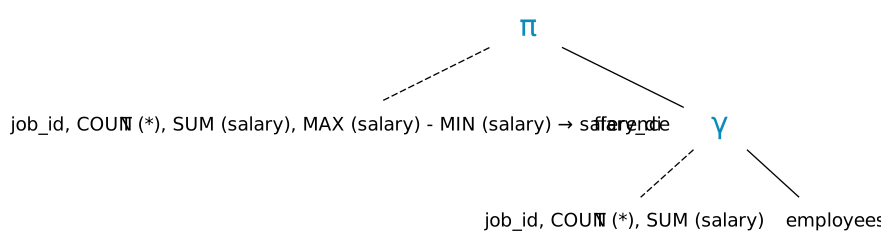
Relational Algebra Expression:

Relational Algebra Tree:
Go to:
PREV : Find employees who did two or more jobs in the past.
NEXT : Jobs done by two or more for more than 300 days.
Practice Online
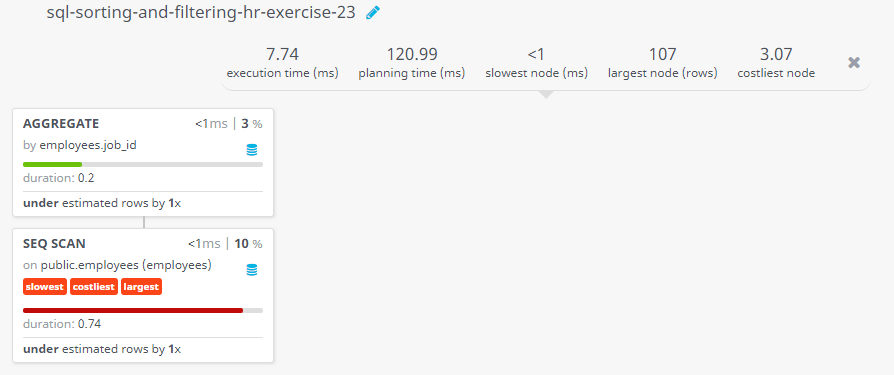
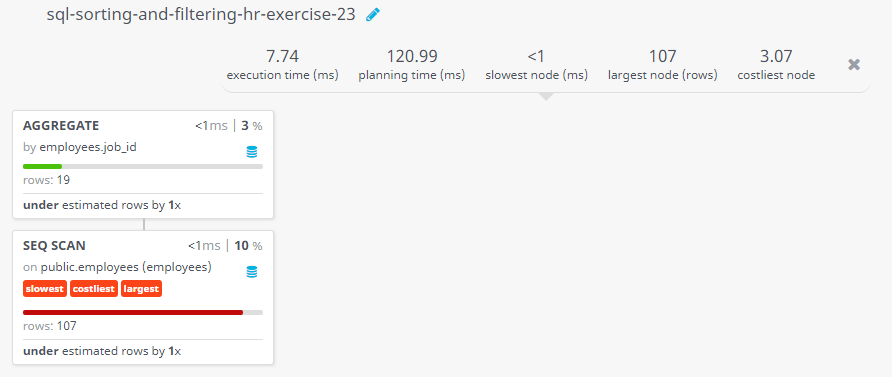
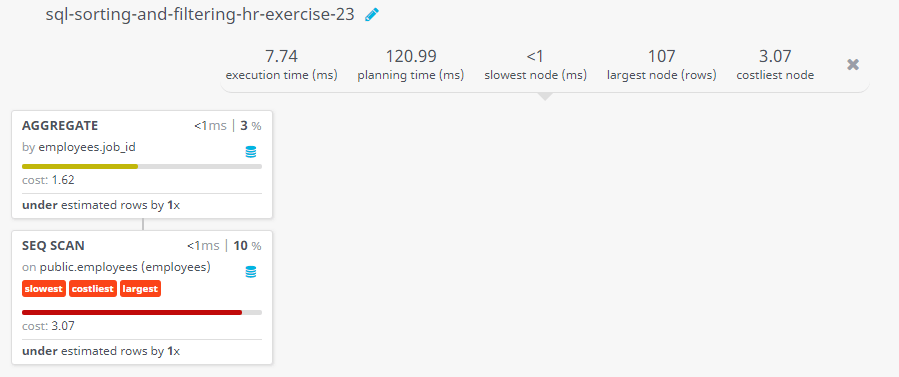
Query Visualization:
Duration:
Rows:
Cost:
Contribute your code and comments through Disqus.
What is the difficulty level of this exercise?
Test your Programming skills with w3resource's quiz.