
SQL Exercises: View to keep track the number of customers ordering
5. From the following table, create a view to count the number of unique customers, compute the average and the total purchase amount of customer orders by each date.
Sample table: orders
ord_no      purch_amt   ord_date    customer_id  salesman_id
----------  ----------  ----------  -----------  -----------
70001       150.5       2012-10-05  3005         5002
70009       270.65      2012-09-10  3001         5005
70002       65.26       2012-10-05  3002         5001
70004       110.5       2012-08-17  3009         5003
70007       948.5       2012-09-10  3005         5002
70005       2400.6      2012-07-27  3007         5001
70008       5760        2012-09-10  3002         5001
70010       1983.43     2012-10-10  3004         5006
70003       2480.4      2012-10-10  3009         5003
70012       250.45      2012-06-27  3008         5002
70011       75.29       2012-08-17  3003         5007
70013       3045.6      2012-04-25  3002         5001
Sample table: Customer
 customer_id |   cust_name    |    city    | grade | salesman_id
-------------+----------------+------------+-------+-------------
        3002 | Nick Rimando   | New York   |   100 |        5001
        3007 | Brad Davis     | New York   |   200 |        5001
        3005 | Graham Zusi    | California |   200 |        5002
        3008 | Julian Green   | London     |   300 |        5002
        3004 | Fabian Johnson | Paris      |   300 |        5006
        3009 | Geoff Cameron  | Berlin     |   100 |        5003
        3003 | Jozy Altidor   | Moscow     |   200 |        5007
        3001 | Brad Guzan     | London     |       |        5005
Sample Solution:
-- Creating a VIEW named 'totalforday'
CREATE VIEW totalforday

-- Selecting columns 'ord_date', count of distinct 'customer_id', average 'purch_amt', and total 'purch_amt' from the 'orders' table
-- Grouping the result by the 'ord_date' column
AS SELECT ord_date, COUNT(DISTINCT customer_id), AVG(purch_amt), SUM(purch_amt)
FROM orders
GROUP BY ord_date;
output:
sqlpractice=# SELECT *
sqlpractice-# FROM totalforday;
  ord_date  | count |          avg          |   sum
------------+-------+-----------------------+---------
 2012-04-25 |     1 | 3045.6000000000000000 | 3045.60
 2012-06-27 |     1 |  250.4500000000000000 |  250.45
 2012-07-27 |     1 | 2400.6000000000000000 | 2400.60
 2012-08-17 |     3 |   95.2633333333333333 |  285.79
 2012-09-10 |     3 | 2326.3833333333333333 | 6979.15
 2012-09-22 |     1 |  322.0000000000000000 |  322.00
 2012-10-05 |     2 |  132.6300000000000000 |  265.26
 2012-10-10 |     2 | 2231.9150000000000000 | 4463.83
(8 rows)
Code Explanation:
The SQL statement creates a view called "totalforday" that shows the order date, the total number of distinct customers who made orders on that date, the average purchase amount for orders made on that date, and sums the total purchase amount for orders made on that date.
The results are grouped by order date.
Go to:
PREV : View to count many customers at each lavel of grade.
NEXT : View to show for each order the salesman and customer.
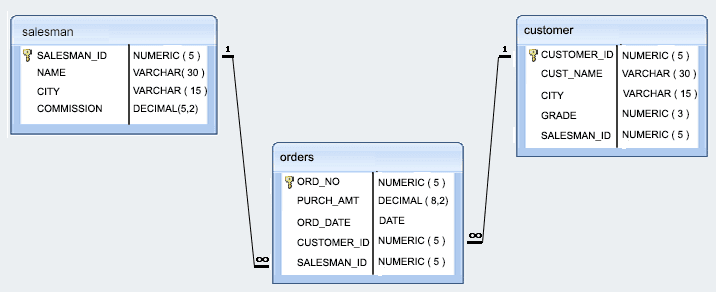
Inventory database model:
Contribute your code and comments through Disqus.
What is the difficulty level of this exercise?
Test your Programming skills with w3resource's quiz.