
PostgreSQL SUBSTR() function
SUBSTR() function
The PostgreSQL substr() function is used to extract a specific number of characters from a particular position of a string.
Uses of SUBSTR() Function
- Extract Substrings: Retrieve a portion of a string starting from a specified position.
- Data Transformation: Manipulate strings for formatting or reformatting purposes.
- String Analysis: Extract meaningful parts of data fields for analysis.
- Conditional Queries: Filter rows based on the extracted substring.
- Dynamic Data Retrieval: Obtain variable-length substrings from columns based on specific criteria.
Syntax:
substr(<string>,<position_from > [,<number_of_characters>]
Parameters:
| Name | Description | Return Type |
|---|---|---|
| string | A string, in which the search will occur. | text |
| position_from | The starting position of search from the string. | integer |
| number_of_characters | A substring which may be one or more characters will be extracted from the string. | text |
PostgreSQL Version: 9.3
Visual Presentation of PostgreSQL SUBSTR() function
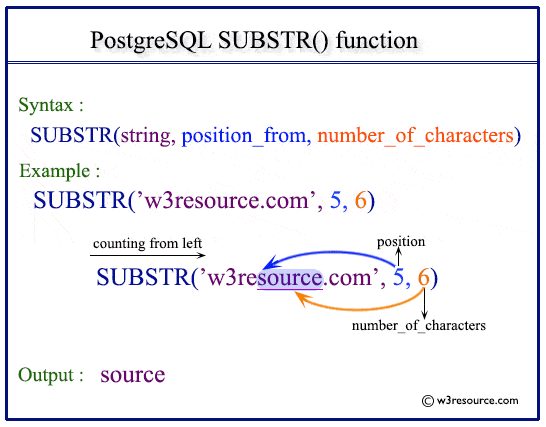
Example: PostgreSQL SUBSTR() function:
In the example below, three characters from the second position of the string 'w3resource' have been extracted.
SQL Code:
SELECT substr('w3resource',2,3) AS "Extracting characters";
Output:
 Extracting characters
-----------------------
 3re
(1 row)
PostgreSQL SUBSTR() function using column:
Sample Table: employees.
 employee_id | first_name  |  last_name  |  email   |    phone_number    | hire_date  |   job_id   |  salary  | commission_pct | manager_id | department_id
-------------+-------------+-------------+----------+--------------------+------------+------------+----------+----------------+------------+---------------
         100 | Steven      | King        | SKING    | 515.123.4567       | 1987-06-17 | AD_PRES    | 24000.00 |           0.00 |          0 |            90
         101 | Neena       | Kochhar     | NKOCHHAR | 515.123.4568       | 1987-06-18 | AD_VP      | 17000.00 |           0.00 |        100 |            90
         102 | Lex         | De Haan     | LDEHAAN  | 515.123.4569       | 1987-06-19 | AD_VP      | 17000.00 |           0.00 |        100 |            90
         103 | Alexander   | Hunold      | AHUNOLD  | 590.423.4567       | 1987-06-20 | IT_PROG    |  9000.00 |           0.00 |        102 |            60
         104 | Bruce       | Ernst       | BERNST   | 590.423.4568       | 1987-06-21 | IT_PROG    |  6000.00 |           0.00 |        103 |            60
         105 | David       | Austin      | DAUSTIN  | 590.423.4569       | 1987-06-22 | IT_PROG    |  4800.00 |           0.00 |        103 |            60
         106 | Valli       | Pataballa   | VPATABAL | 590.423.4560       | 1987-06-23 | IT_PROG    |  4800.00 |           0.00 |        103 |            60
         107 | Diana       | Lorentz     | DLORENTZ | 590.423.5567       | 1987-06-24 | IT_PROG    |  4200.00 |           0.00 |        103 |            60
         108 | Nancy       | Greenberg   | NGREENBE | 515.124.4569       | 1987-06-25 | FI_MGR     | 12000.00 |           0.00 |        101 |           100
         109 | Daniel      | Faviet      | DFAVIET  | 515.124.4169       | 1987-06-26 | FI_ACCOUNT |  9000.00 |           0.00 |        108 |           100
		 ..................
         206 | William     | Gietz       | WGIETZ   | 515.123.8181       | 1987-10-01 | AC_ACCOUNT |  8300.00 |           0.00 |        205 |           110
If we want to display the first_name, job_id, and the extraction of three characters from the second position of first_name column from employees table for those employees who drawn the salary of more than 12000, the following SQL can be used.
SQL Code:
SELECT first_name,job_id,
substr(first_name,2,3) AS "Extracting characters"
FROM employees
WHERE salary>12000;
Output:
 first_name | job_id  | Extracting characters
------------+---------+-----------------------
 Steven     | AD_PRES | tev
 Neena      | AD_VP   | een
 Lex        | AD_VP   | ex
 John       | SA_MAN  | ohn
 Karen      | SA_MAN  | are
 Michael    | MK_MAN  | ich
(6 rows)
PREV : STRPOS function
NEXT : TRANSLATE function